INTRODUCTION TO THEME
Hi everyone, great to be with you all here again. Today is the second Sunday after Pentecost, and, after all the drama and excitement of Lent, Easter, Pentecost, then last week Trinity Sunday (which doubled as Reconciliation Sunday), we resume our Lectionary Year A journey through the Gospel of Matthew, picking up the story from Chapter 9.
It’s the perfect place to resume the story, in fact, because in this chapter we get the basic message, formula of the Gospel elaborated in full – it’s like “The Gospel 101”! Our reading today comprises three short episodes, which appear in all three synoptic Gospels, Mark and Luke, as well as Matthew.
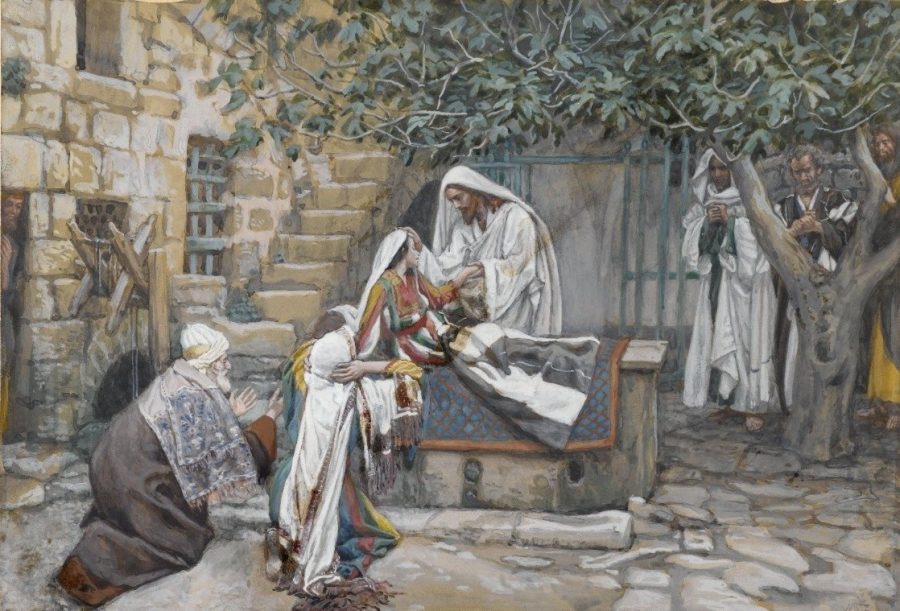
Firstly, we have the calling of the apostle Matthew, the tax collector. Then we have two well-known miracle stories told together: the raising of Jairus’s daughter – you can see a nice depiction of it by the French artist, James Tissot (c. 1890) – and the healing of an unknown woman from a flow of blood.
The Gospel 101: Grace, Faith, Metanoia – our theme for today. Today’s three little stories show the basics of how the Gospel works in our lives: grace unlocks faith, which brings about metanoia – spiritual transformation – empowering us to become better, more selfless people.
GOSPEL READING: Matthew 9:9-13, 18-26
9:9 As Jesus was walking along, he saw a man called Matthew sitting at the tax-collection station, and he said to him, “Follow me.” And he got up and followed him.
9:10 And as he sat at dinner in the house, many tax collectors and sinners came and were sitting with Jesus and his disciples.
9:11 When the Pharisees saw this, they said to his disciples, “Why does your teacher eat with tax collectors and sinners?”
9:12 But when he heard this, he said, “Those who are well have no need of a physician, but those who are sick.
9:13 Go and learn what this means, ‘I desire mercy, not sacrifice.’ For I have not come to call the righteous but sinners.”
9:18 While he was saying these things to them, suddenly a leader came in and knelt before him, saying, “My daughter has just died, but come and lay your hand on her, and she will live.”
9:19 And Jesus got up and followed him, with his disciples.
9:20 Then suddenly a woman who had been suffering from a flow of blood for twelve years came up behind him and touched the fringe of his cloak,
9:21 for she was saying to herself, “If I only touch his cloak, I will be made well.”
9:22 Jesus turned, and seeing her he said, “Take heart, daughter; your faith has made you well.” and the woman was made well from that moment.
9:23 When Jesus came to the leader’s house and saw the flute players and the crowd making a commotion,
9:24 he said, “Go away, for the girl is not dead but sleeping.” And they laughed at him.
9:25 But when the crowd had been put outside, he went in and took her by the hand, and the girl got up.
9:26 And the report of this spread through all of that district.
REFLECTION
So, the calling of Matthew, and two wonderful miracles, encapsulating the basic Gospel formula: Grace, Faith, Metanoia. Let’s go through the passage with a fine-toothed comb and see how it all works.
“As Jesus was walking along he saw a man called Matthew sitting at the tax-collection station, and said to him, ‘Follow me.’ And he got up and followed him.”
Just like that apparently: without hesitating, Matthew got up and followed Jesus! Why? None of the three Gospel accounts of Matthew’s calling give any direct clue as to what was going on in his life leading up to this, apart from the fact that he was a tax collector. Presumably Matthew had heard about Jesus, maybe he had an inkling Jesus could help him in some way, but that doesn’t explain him throwing away his career as a tax collector in an instant and following Jesus just because Jesus walks by and invites him to.
The word we’re looking for to explain Matthew’s abrupt action is, in fact, grace. Jesus exuded grace; the air around him, anywhere near him, was tingling with grace, real spiritual energy there for Matthew, for any of us, to tap into. It filled Matthew with real energy, agency, so that he was able to step out in faith, drop everything and follow Jesus.
We’ll come back to grace and faith shortly, with the two miracle stories; but the question is, what is this injection of grace, this stepping out in faith, actually for? Or to put it another way, what was it that Matthew needed help with? – what exactly was wrong in his life? Well, Jesus gives the answer in the next part of the passage:
“… as he sat at dinner in the house, many tax collectors and sinners came and were sitting with Jesus and his disciples. When the Pharisees saw this, they said … ‘Why does your teacher eat with tax collectors and sinners?’”
Tax collectors and sinners, bracketed together: basically, collecting tax, at this time and place, is a sin, with Jewish locals like Matthew turning against their own community to collect taxes for the oppressive occupying power of the day, the Romans. Collaboration with the enemy, betraying your own people – almost the worst type of sin. You know, in Dante’s Inferno, his amazing 14th century prose poem vision of Hell, the 4th and final round of the 9th and lowest circle of hell, reserved for the worst of all sinners, the betrayers, is named, appropriately, for the man considered to be the greatest traitor in all of history: Judecca – Judas, no less!
Matthew: tax collector, traitor, sinner. Jesus then provides the perfect response to the Pharisees’ challenge:
“Those who are well have no need of a physician, [rather] those who are sick… I have not come to call the righteous but sinners.”
Ah, but there is a word missing here. Old translations of this verse have:
“I have not come to call the righteous but sinners … to repentance”
This, in fact, is what the corresponding verse in Luke’s account of the calling of Matthew adds: “to repentance” – Luke 5:32, Luke actually calls Matthew “Levi”. And the Greek word, translated as “repentance”, every time Jesus says it, is, of course, metanoia! Yes, I talk about it every time I’m here; it’s really the core of the Gospel. Meta-noia, a complete change in your mindset, a spiritual transformation, you turn your life around, no longer living selfishly, just for yourself – like greedy Matthew, the tax collector, happily in the pay of the Romans, ripping off his own people – but living more selflessly, caring for and serving others, not exploiting them for your own ends.
I call it Repentance+. Repentance – realizing, recognizing, your own selfish sinfulness, like Matthew did – is just the beginning of the process. Then you receive grace, empowering you with the faith to follow Jesus, to undergo metanoia, to start becoming a better, more selfless person. This is the Gospel formula, it really works! – grace/faith gives you wings!
“While he was saying these things to them, suddenly a leader came in and knelt before him, saying, ‘My daughter has just died, but come and lay your hand on her, and she will live.’”
Both Mark’s and Luke’s account identify the leader, of the synagogue, as Jairus. What an amazing thing for such a person to do, to come to Jesus, who is not a formally qualified religious leader of any sort, and kneel before him – think of all the pride being swallowed! Again, it’s unaccountable. Like Matthew, Jairus probably had some inkling that Jesus could help him, help his daughter; but to act like that – to seek Jesus out, kneel before him, then boldly say, “My daughter has just died, but come and lay your hand on her, and she will live” – unaccountable, inexplicable!
Again, however, the explanation is all that grace Jesus is exuding at this time, that he’s literally radiating out into the social, cultural, virtual space around him. Jairus is drawn to Jesus as if to a magnet, the grace pours into him, empowering him to swallow his pride – a sin at least as primal as betrayal – and step out in faith, trusting that Jesus can heal his daughter, in the process undergoing his own personal metanoia, becoming a better, less prideful, more selfless person.
“Then suddenly a woman who had been suffering from a flow of blood for twelve years came up behind Jesus and touched the fringe of his cloak, for she was saying to herself, “If I only touch his cloak, I will be made well.”
With all that grace radiating out into the space around him, this is the effect Jesus has on people – the effect the Holy Spirit can have on us now, if we but open ourselves up in faith to it. The woman would have had her own pride to swallow, all those years of shame, of rejection by her own people. The grace reached her where she was and drew her to Jesus, like a magnetic force, gave her the faith to touch his cloak and believe she would be healed.
“At once Jesus realized that power had gone out from him. He turned around in the crowd and asked, ‘Who touched my clothes?’”
That’s from Mark’s account (5:30). “Power had gone out from him” – yes, grace, real spiritual energy to empower us to act in faith, undergo metanoia, to become better, more selfless people.
“Jesus turned, and seeing her he said, ‘Take heart, daughter; your faith has made you well.’ and the woman was made well from that moment.”
So, the woman was healed from her flow of blood, released from all that pain, shame and rejection. And Jarius’s daughter?
“[Jesus] said, ‘ …. the girl is not dead but sleeping.’ And they laughed at him. But when the crowd had been put outside, he went in and took her by the hand, and the girl got up.”
Yes, such miracles are marvellous things, and the grace continues to flow in the world, now through the Spirit, as Jesus promised, not just transforming individual lives, but also transforming culture. Our understanding of the human body and disease has undergone an amazing metanoia of its own, so that many or most of the diseases and conditions that were endemic, untreatable, fatal back in Jesus’ day, are now treatable, people can survive, have good quality of life – life expectancy in many parts of the world now is 80+, compared to around 35 back then. And sick people aren’t commonly discriminated against, ostracized, as they were back then; rather they are usually able to receive the very best of help and care. Metanoia of culture and society: what Jesus called the Kingdom of God, still a work in progress of course, but well on the way.
Yes, it all starts with grace: grace that Jesus radiated in an amazing way back then, grace that is available to us now, 24/7, through the Holy Spirit. It is a completely objective, concrete thing – Jesus felt real power, spiritual power, going out from him. Something that we just imagined, that was purely subjective, couldn’t possibly transform individual lives, transform culture. Grace radiating out into the space around him, tingling in the air. I liken it to a field of spiritual force, a grace field—think The Force in Star Wars, except all light-side—which exerts a constant, positive pressure on our lives, just waiting to be accessed, activated.
Don’t wait for a crisis to come – you realize that the path you’re on in life is basically a self-seeking ego-trip, you or one of your loved ones become very sick. As I said last time I was here, prevention is better than cure! This is what confessional prayer is all about: praying regularly, acknowledging the self-centredness that we always struggle with, opening ourselves up in faith to receive regular download doses of grace, real spiritual energy and agency, to help us undergo metanoia and become better, more selfless people.
So, The Gospel 101, our theme for today: Grace, Faith, Metanoia – I commend it to you most wholeheartedly. Amen!