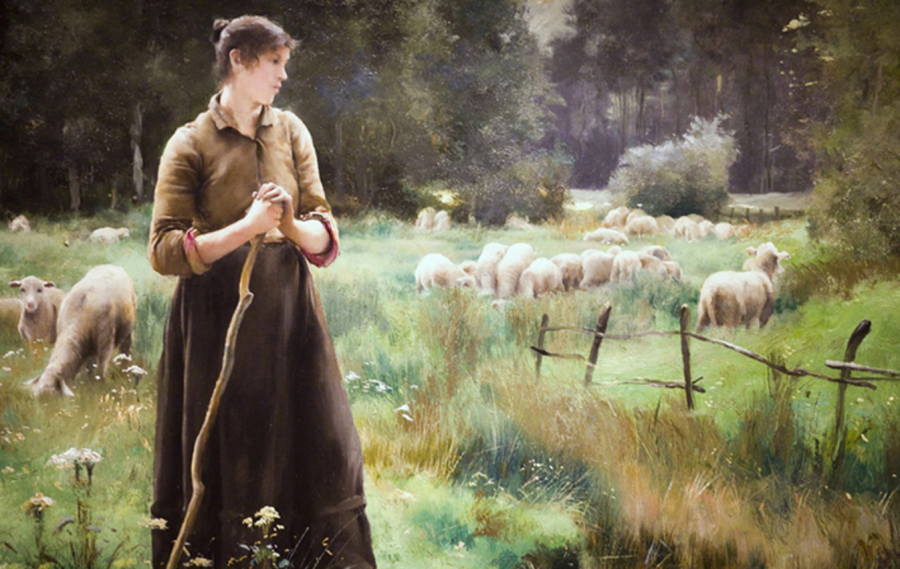
Picture: The Good Shepherd by Julien Dupre 1851-1910
INTRODUCTION
Hi everyone. Great to see you all again. Today is Good Shepherd Sunday, which we celebrate around this time every year, with the focus on the Story of the Good Shepherd from John’s Gospel—or at least, this year, the first part of the story, Chapter 10, verses 1-10. It’s a beautiful allegory: we are the sheep; Jesus is our shepherd. But is it just a nice, cosy, comforting allegory, or does it contain a deeper, more profound truth? Jesus’s voice throughout the story has a real sense of urgency to it – he eventually goes so far as to say, “I lay down my life for the sheep” – something shepherds don’t normally do! The key to understanding the real depth of the story, as we’ll see in the reflection coming up, is the simple realization that we are not actually sheep, but human beings – and this, it turns out, makes all the difference!
GOSPEL READING: John 10:1-10
10:1 Very truly, I tell you, anyone who does not enter the sheepfold by the gate but climbs in by another way is a thief and a bandit.
10:2 The one who enters by the gate is the shepherd of the sheep.
10:3 The gatekeeper opens the gate for him, and the sheep hear his voice. He calls his own sheep by name and leads them out.
10:4 When he has brought out all his own, he goes ahead of them, and the sheep follow him because they know his voice.
10:5 They will not follow a stranger, but they will run from him because they do not know the voice of strangers.”
10:6 Jesus used this figure of speech with them, but they did not understand what he was saying to them.
10:7 So again Jesus said to them, “Very truly, I tell you, I am the gate for the sheep.
10:8 All who came before me are thieves and bandits, but the sheep did not listen to them.
10:9 I am the gate. Whoever enters by me will be saved and will come in and go out and find pasture.
10:10 The thief comes only to steal and kill and destroy. I came that they may have life and have it abundantly.”
REFLECTION
“I am the good shepherd”, Jesus goes on from verse 10 where we just read, “The good shepherd lays down his life for the sheep. The hired hand, who is not the shepherd and does not own the sheep, sees the wolf coming and leaves the sheep and runs away, and the wolf snatches them and scatters them ….. I am the good shepherd, I know my own, and my own know me ….. And I lay down my life for the sheep” – Jesus repeats – “they will listen to my voice. So, there will be one flock, one shepherd….”
It’s a beautiful, allegorical story – unique to John’s Gospel, by the way, and, typically for John, replete with direct, personal statements by Jesus: “I am”, “I know”, “I lay down my life”, “my own”, “my voice”. The centrepiece of the story is the relationship between the (good) shepherd and the sheep: the deep, almost blind, instinctive faith and trust the sheep have in their shepherd, and the pay-off this faith and trust ultimately brings: not just protection, but abundant life. This is for us, of course; but, as I noted in my introduction, we are not actually sheep, so Jesus is not our literal shepherd, and, moreover, the sort of faith and trust that sheep might naturally have for their shepherd is just not something that comes naturally to us human beings at all; it is, for us, essentially problematic. So here is the real urgency and depth of the story: how can we find the faith, trust, belief we need, to bring us through to the abundant life that Jesus offers us? And for that matter, what exactly is this “abundant life”?
*******************
We are not sheep. What, in fact, is the fundamental difference between us and sheep; between us and all other animals? Well, physically, biologically, not much at all—we are basically evolved animals. But psychologically we are on another planet! We have a psychological superpower which has enabled us to develop all the things uniquely human – language, culture, religion, science, technology, society, civilisation – so that we are now unrivalled rulers of the planet and might be rocketing off to the moon (again) and even Mars sometime soon. And, yes, it has made us so powerful that we now actually threaten the continued existence, not just of our own species, but all living species, through potentially catastrophic global warming and nuclear conflict – help! A psychological superpower which is both our greatest blessing and, yes, our greatest curse! What is it?!
No, it’s not magic! – simply, we have self-consciousness: we are conscious of ourselves as selves and others as selves, in a way that no other animal is. This, I believe, is what the biblical writers were trying to get at when they described humans as having been created “in imago dei”, “in the image of God” – that’s Genesis 1:27.
I hang around cats, you probably hang around cats, dogs, horses, sheep, pigs, cattle, birds …. Unlike us, they don’t have a self-concept. Even in a little infant, with pet cats or dogs around, you can quickly start to see the difference – cats, for example, are often pretty wary of little kids, because their self-consciousness makes them wilfully unpredictable to the unselfconscious cat. No put-down to animals: it’s their natural lack of self-consciousness that we love, even admire or envy – or exploit, as the case may be.
A blessing and a curse; our superpower and our Achilles’ heel. Self-consciousness turbo-charges our psychological, social, cultural evolution, but it also makes us capable of something no other animal has the capacity for: conscious, intentional, wilful selfish behaviour – a.k.a. sin! Help – again! This is truly the cause of all our problems, everything from little kids not playing nicely together in the playground, to, yes, the threats of global warming and nuclear conflict: intentional, sinful selfishness.
Faith? Self-consciousness gives us an outsized, overblown, positively dangerous, faith, trust, belief in … ourselves! We’re the original egotists, narcissists – every last one of us, we’re born that way! Self-belief is an important thing, an essential thing for life, but ours is always in danger of getting out of control, going too far.
This, then, in relation to the Good Shepherd story, is the core of the problem we have: our natural faith, belief, trust in ourselves is the very thing that, at critical moments in our lives, blocks us from opening ourselves up to the faith, trust, belief in God, through the Spirit, that we need to bring us through to the abundant life that Jesus promises.
It’s a spiritual abundance in our lives right now, by the way – we’ll get to that shortly. But what are these critical moments, when we need to find a way of letting go of our faith, belief, trust in ourselves, in order to open ourselves up the sort of 100% faith, trust, belief in God that Jesus calls us to? Not all the time, obviously; but, critically, in those moments when we come to a realization that, once again, it is our stupid selfish actions, our sin, that has got us into the pickle we’re in. Light-bulb moments, usually very painful – “ah, I’ve done it again, what a selfish idiot I am!”
This is the protection, the salvation, Jesus, the Good Shepherd offers: protecting us, saving us, from our own selfish, sinful selves, at those critical moments of self-realization – when the strangers, thieves, bandits, hirelings, wolves, of self, threaten us – helping us let go – and oh how we need the help! – of our faith and trust in ourselves, putting our faith and trust instead in God, through the Spirit. It’s an incredibly unnatural thing for any of us to do – every fibre of our being rebels against it!
When we do manage to do it, however – and hopefully get into the habit of doing it regularly – what we receive, through the Spirit, is truly wonderful: a download of real spiritual energy and agency, to help us stop being so sinfully selfish, and become better, more selfless people, starting to break through to the abundant life that Jesus, the Good Shepherd, offers. Because that is what abundance of life truly is: living more selflessly, becoming a better person for others, no longer being dragged down by all the worry, anxiety and fear that our natural self-centredness brings.
“A download of spiritual energy and agency to help us stop being so sinfully selfish”: the word we’re looking for here is METANOIA – I talk about it in nearly every sermon I give, here and in other places. It’s the Greek word in the New Testament typically translated as “repent”. Repent, change, turn out your life around, Jesus says over and over again. “Meta-” – change or transformation – “-noia” from the Greek, “nous”, “mind”. Thus, a transformation in your whole mindset: from your natural-born mindset of self-centredness, to a new, more open, abundant mindset of selflessness, living for and serving others. But, yes, we can’t make it happen ourselves, we have to let go of our self-belief – in those critical moments that occur in our lives – receiving in its place, through the Spirit, a download of new spiritual energy and agency which then restores and enhances our personal agency, to go out and live the abundant, selfless life Jesus offers.
It’s a gradual process of what theologians call “sanctification”– becoming more holy, more Jesus-like in your life. Better, in fact, not to wait for those critical moments to just happen, however; rather get into the habit of doing it regularly – prevention is better than cure! This is what confessional prayer is about: praying regularly, acknowledging the self-centredness that we always struggle with, opening ourselves up to receiving – yes, I’m saying it again – regular download doses of spiritual energy and agency, to help us become better, more selfless people.
*******************
“The thief” – of sinful selfishness – “comes only to steal and kill and destroy”; “I” – Jesus, the Good Shepherd – “came that they may have life and have it abundantly”. No, we are not sheep – although our human lives can become so complex and messy that sometimes we yearn for the simplicity of a sheep’s life – and because we are not sheep, because we are uniquely self-conscious creatures, God sent Jesus into the world to save us, humans, from … ourselves – so that, through 100%, sheep-like faith, trust, belief in God, now through the Spirit, we can undergo Metanoia and start to become better, more selfless people. To the benefit not just of ourselves, but of all creatures, all the world – a world that is now in dire need of being saved from us! Which, of course, is the wonderful Kingdom Jesus continually proclaimed, growing now, all around us.
“Thy Kingdom come, thy will be done, on earth now as it is in heaven.” Amen.