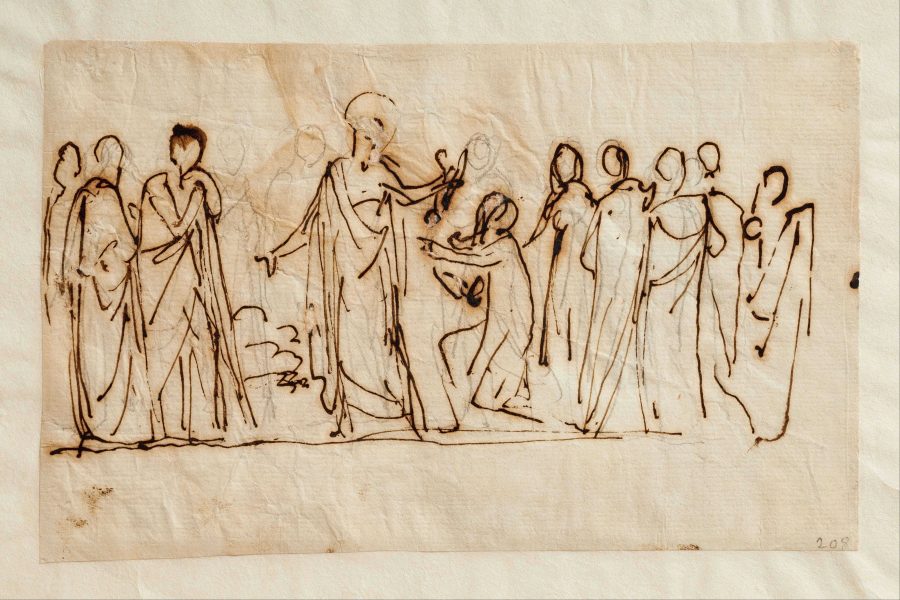
Dear old Peter, he’s what you’d refer to these days as a “polarizing figure”. Two Sundays ago, in Matthew 14, when, showing off, he tries unsuccessfully to copy Jesus’ feat of walking on water, Jesus admonishes him: “O you of little faith, why did you doubt me?” This coming Sunday, in Matthew 16, showing off again probably, he seems to get it completely right when he tells Jesus in verse 16, “You are the Messiah, the Son of the living God”, winning Jesus’ hearty endorsement:
“Blessed are you, Simon son of Jonah! … And I tell you, you are Peter, and on this rock I will build my church, and the gates of Hades will not prevail against it. I will give you the keys of the kingdom of heaven … “
It won’t be long, however, before he gets it wrong again big-time, when he denies Jesus thrice before the cock crows in Matthew 26. What about after Jesus’ departure? – well, perhaps then he finally stops being polarizing; becoming, instead, as Jesus had confidently predicted, a true rock of the early church.
Why did I say “seems” to get it right? Well, the problem is that, even though Peter appears, in this episode, to fully embrace Jesus as Messiah, it’s almost certain that he, and the other disciples along with him, had the wrong idea of the sort of Messiah Jesus would actually turn out to be. The Messiah of Jewish tradition, who Peter was now identifying Jesus with, was prophesied to be a mighty king in the line of the great King David who would vanquish the Romans and restore Israel to its former glory – and the last thing such a Messiah would do is get themself arrested and executed by those self-same Romans!
In fact, Jesus turned out to be a Messiah not to save us from the Romans, but from … ourselves! Thus, there is a tyrant, far greater than any mere Roman emperor, operational in our lives, and we know exactly who it is: our own natural-born self-centred selves. A friend once told me a lovely aphorism which not even Chat GPT can trace:
“Who’s in charge, loving God or tyrannical me?!”
I commend it to you; and highly recommend, moreover, that you get in touch with this inner tyrant of yours, and let the Spirit loose on it, infusing you with the grace you need to be able to, in faith, let go of your selfish grasping and get on with the job of becoming a better, more selfless person – the wonderful inner transformation that Jesus describes as “metanoia” (repentance, conversion) and Paul refers to as “sanctification”.
Yes, good old Peter, the “everyman” we identify with so closely, because we recognize his faults in ourselves, at the same time as aspiring to follow the trail he blazed to becoming a person of true courage and faith.
Cover Image: Christ gives the keys of the kingdom to Peter, Bertel Thorvaldsen, c.1817-1818. Vanderbilt University Divinity Library