INTRODUCTION
Good morning, everyone. Today is the 11th Sunday after Pentecost, and we continue our wonderful journey in the Lectionary through the Gospel of Matthew. Last week we were in the first part of Matthew 14 with the feeding of the 5000, which S___ talked to us about; this week we’re in the second half of the chapter, with the famous story of Jesus walking on water, and Peter trying to walk on water but ending up sinking. “Don’t try this at home”, might have been a good title for our service, but M___ had already decided to call it, “Faith in storms of life”, so I prevailed on him to add a question mark – which you can see there on the screen – because what Jesus is basically saying to us in this story is, if we wait till the storms of life to come to live by faith, it’ll probably be too late, we’ll probably just sink like a stone! Underlying this is the profound truth that faith itself is essentially problematic, it always has a question mark after it.
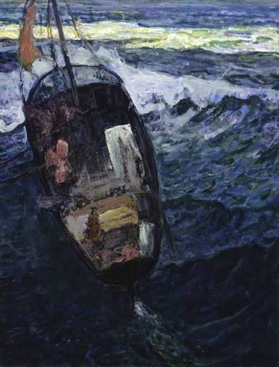
We’ll try to get to the bottom of all this – not the sea, the faith question – in the message coming up a bit later in the service. There’s the nice picture on the screen, Fisherman at Sea by the African-American painter Henry Ossawa Tanner, 1913 – an actual depiction of the storm in Matthew 14 – hope you like it.
GOSPEL READING: Matthew 14:22–33
Jesus walks on water but Peter sinks
14:22 Immediately he made the disciples get into a boat and go on ahead to the other side, while he dismissed the crowds.
14:23 And after he had dismissed the crowds, he went up the mountain by himself to pray. When evening came, he was there alone,
14:24 but by this time the boat, battered by the waves, was far from the land, for the wind was against them.
14:25 And early in the morning he came walking toward them on the sea.
14:26 But when the disciples saw him walking on the sea, they were terrified, saying, “It is a ghost!” And they cried out in fear.
14:27 But immediately Jesus spoke to them and said, “Take heart, it is I; do not be afraid.”
14:28 Peter answered him, “Lord, if it is you, command me to come to you on the water.”
14:29 He said, “Come.” So Peter got out of the boat, started walking on the water, and came toward Jesus.
14:30 But when he noticed the strong wind, he became frightened, and, beginning to sink, he cried out, “Lord, save me!”
14:31 Jesus immediately reached out his hand and caught him, saying to him, “You of little faith, why did you doubt?”
14:32 When they got into the boat, the wind ceased.
14:33 And those in the boat worshiped him, saying, “Truly you are the Son of God.”
REFLECTION
So, yes, the familiar, iconic story of Jesus walking on water – on the Sea of Galilee, in a storm – and Peter trying, but not succeeding, to copy him. Following straight on from last week’s story of the feeding of the 5000.
On one hand, as with all of Jesus’ miracles, Jesus walking on water is a sign – that’s how John describes them in his Gospel – a sign to all and sundry of exactly who Jesus is. And the disciples certainly get the message, when they say at the end of today’s passage, “Truly you are the Son of God.”
But, on the other hand, Jesus is, through this story, teaching the disciples, Peter especially, a very timely lesson about that most vital of human qualities, faith. So that the really important part of this story, for us now, is not so much that Jesus succeeded in walking on water, but that Peter failed! In this sense, the story is a cautionary tale: as I said in my intro, don’t wait till the storms of life come to start nurturing and practising your faith, because you’ll probably just sink like a stone; rather, start now!
Yes, faith: the most vital of human qualities to acquire; but it is essentially problematic because it doesn’t come naturally to us—certainly not the kind of faith we’re talking about here, faith in a God who is literally invisible – such faith we can only acquire by learning. Which means that we need someone, or someones, to teach it to us. Let’s now really drill down on this amazing little quality, faith, that we’d dearly love to get our hands on: what exactly is it, what is it for, how indeed do we get our hands on it?
*****************
So, faith. In Matthew 14:31, when Jesus delivers the punchline of today’s story, “You of little faith, why did you doubt?”, the root of the Greek word, translated into English as “faith”, is “pistis”. Now do you know that anywhere you read in the New Testament not just the word “faith”, but also “belief” and “trust”, the Greek root word is always the same, “pistis”. An old pastor friend pointed this out to me a few years ago, and it was a real revelation. Faith, trust and belief, out of the mouth of Jesus and all the New Testament writers, are, in fact, the same one thing. He, my pastor friend, preferred always, in fact, to use the word “trust”—that is, a deep seated, visceral reliance on someone. Because, particularly the word “believe”, has come to mean something quite different in the modern era, something more shallow, purely intellectual, belief in abstract propositions; not something that has a real influence on our behaviour, on how we live our lives. So, when Jesus says to Peter in the second part of verse 31, “why did you doubt?”, he really means, “why did you not trust me?” Do you see the difference?! “Trust me with your life”, Jesus might now say to us, “don’t just believe in me!”
In Romans 10, the New Testament lectionary reading for today, Paul emphasizes this point twice in two verses, when he says, not just “believe”, but “believe in [or with] your heart”:
“… because if you confess with your mouth that Jesus is Lord and believe in your heart that God raised him from the dead, you will be saved. For one believes with the heart, leading to righteousness, and so is justified …” (Verses 9-10)
So, “trust”, or if you want to use the word “believe”, say “believe with my heart”. Faith, trust, believing with my heart—all the same one thing.
*****************
Now, where, or when, does the whole faith, trust, belief thing begin in our lives? Well, it starts early on, when we are little children, with our parents teaching us that most vital of things, how to behave and live cooperatively with others in community and society; how to be able to, sometimes at least, let go of our self-interest in favour of the interests of others—some capacity for unselfishness, selflessness, in other words. Yes, I know this is my favourite thing to talk about, and here I am again talking about it!
The word is Metanoia: the gradual transformation of individual humans from our natural-born state of self-absorption to one of being able to cooperate selflessly with others. And Kingdom: the gradual Metanoia of all humanity.
Faith is the driver of Metanoia, for each of us. But faith doesn’t come to us naturally, as I said, it can only get going in our lives through outside intervention, by the Spirit. This intervention is what we call Grace: when we open ourselves up to the Spirit, we are able to receive regular download doses of Grace, to nurture and grow our Faith, which then propels us through Metanoia, becoming better, more selfless people in the process.
There: I’ve just enunciated the basic formula of the Gospel:
Spirit-Grace-Faith-Metanoia-Kingdom!
But back to us as little children, with our parents. It is, initially, through our parents that Grace comes into our lives, and the faith that is initially nurtured inside us by this grace is, therefore, faith in our parents. This faith—remember we mean deep-seated trust, believing with your heart— is, in turn, vital for us, for the child, to undergo Metanoia, to start learning some of the skills of cooperative living with others.
Think about it; a little child, say a toddler about 2-4 years old, is playing away happily, then grabs a toy they decide they want, from another child close by. The other child starts crying; the parent of the first child intervenes, takes the toy from their child, gives it back to the second child. Then the first child, of course, starts complaining, crying, even throws a tantrum, starts throwing things around the room. Their parent restrains them, firmly but gently, soothes their tears, telling them it’ll be OK if they don’t have the toy in question, that it’s good to share with others and let others have a turn; then probably distracts them with something else to do, and they forget about the toy they can’t have.
Sound familiar?! Do you see the grace—it’s not a physical thing, rather a virtual thing, but completely real—the grace flowing into the child from their parent, nurturing the faith the child has in the parent, giving them the courage and agency to let go of their selfish interest in the toy in question, trusting that their life will be OK, or even better, if they share and give others a turn?
It’s a beautiful thing—but it doesn’t always work of course, it is often problematic. And yes, parents can botch the job of bringing up their children badly, even betray their trust, so that the child might grow up to be a spoilt, selfish narcissist in adulthood, or to suffer chronic anxiety, or both.
But even if the parents do a serviceable job of it, when the child grows to adulthood, they are basically now on their own, so that the source of grace in their lives to keep growing through the Metanoia in the big wide world at large, has to now be, in some degree and in a very real sense, directly from the Spirit. And the faith and trust that is thereby nurtured is faith and trust in … God—yes, in the invisible God who interacts with us, seemingly, not in any physical way, but through the Spirit.
How do we get such grace into our lives, and the faith it then stimulates. Well, don’t wait till you’re in a storm, for something terrible to happen in your life—that’s what Jesus, as I’ve said, is effectively recommending in today’s story. Regular prayer, starting in some sort of confessional mode, where we set aside our habitual self-focus and acknowledge our real need for outside help in our lives; then an opening of ourselves to the Spirit, to receive, yes, regular download doses of grace, spiritual energy and agency, giving us the courage and faith to set aside our own self-focussed desires – a pretty scary thing to do – and instead focus our energy on looking out for others.
And that answers the other question also: what is faith for? Well, it’s certainly not so we can walk on water – we’ve got plenty of great marine technology for that, a.k.a. boats. Nor is it so we can literally move mountains, win a sporting contest, get a new job, get healed from some ailment – not that there’s necessarily anything wrong with those things. Faith is not so we can get something out of God, so we can get God to do something for us. It is for one thing and one thing only: to propel us through Metanoia to do good works in the world, caring for others, working to make the world a better place, bringing God’s Kingdom into reality.
*****************
Back to good old Peter. Yes, you’d be tempted to say that he was basically just showing off by trying to walk on water with Jesus – which is consistent, I think, with the rest of his behaviour to this point in the Gospel story – hence he quickly started sinking. Later Peter denies Jesus three times during the next big storm that comes along—Jesus’ arrest and trial – so not much character development, Metanoia, evident yet. What about after Jesus’ death? Well, yes, maybe then he started to become a great man of faith, a leader of the early Church, the first Bishop of Rome or Pope, by all accounts – only kidding!!
What about us? Well, we’re still a work in progress, each one of us, obviously. So, let’s keep on going down that Metanoia road, always looking to the Spirit to give us the Grace to nurture and grow our Faith—not just shallow intellectual belief, remember, but a deep-seated trust, believing in God and their promises through the Spirit, with all our hearts. And, yes, the wonderful Gospel formula:
Spirit-Grace-Faith-Metanoia-Kingdom!
Amen.
Illustration: Fishermen at Sea, Henry Ossawa Tanner, 1913, Smithsonian American Art Museum, Public Domain